A bare deck costs €74.90 at the median across European shops, and a full setup built part by part comes to somewhere between €150 and €260 depending on where you buy. These are not estimates: they come from measuring the 16,938 products this comparator currently tracks across 78 shops in ten countries. Below: what each part actually costs, the trap hiding in truck prices, and why the same deck can cost twice as much at the shop next door.
What each part actually costs
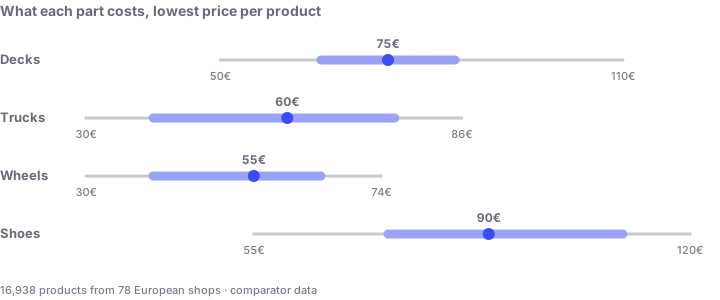
The thick dot is the median; the wide bar is where the middle half of the offer sits; the thin line runs from the cheapest 10% to the most expensive 10%.
| Part | Cheapest 10% | Median | Priciest 10% | Products measured |
|---|---|---|---|---|
| Deck | €49.95 | €74.90 | €110 | 11,005 |
| Trucks | €29.95 | €59.99 | €85.80 | 2,089 |
| Wheels | €29.99 | €55 | €74 | 2,927 |
| Shoes | €54.95 | €89.95 | €119.99 | 900 |
One thing is worth pausing on: these prices are considerably higher than the ones circulating in most online guides, which tend to put a mid-range deck at €45–65. This very guide said so until recently. The reality of the 2026 European market is that barely 10% of the catalog sits under €50, and much of that 10% is kids’ sizes or end-of-line stock.
Bearings are missing from the table, and it is only fair to say why: this comparator tracks just three of them, far too few for a median. The industry reference has not changed: a set of Bones Reds runs about €20, and the ABEC number on the box measures manufacturing tolerance, not how fast you actually roll.
The truck trap: single or pair
If you have looked at truck prices and concluded they are impossible to compare, it is not you. Here is what happens when you take one single model, the Independent Stage 11, and plot the price of every listing:
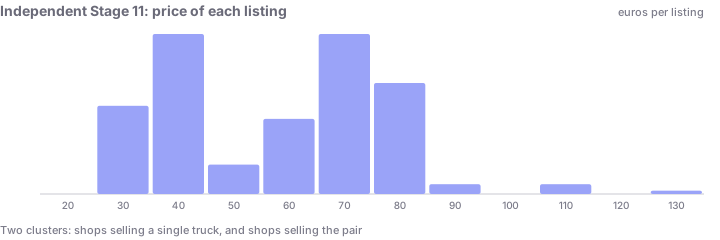
There is not one peak, there are two: one around €40 and another around €70–80. The reason is simple and almost nobody warns you about it: some shops sell a single truck and others sell the pair, and the listing title often does not say which. We found listings tagged “(pair)” in both clusters, so even the label fails to separate them.
The practical rule: if an Independent comes in under €45, assume it is one truck until the shop’s own page says otherwise. A board needs two, and this is the single most common budgeting mistake among people building their first setup.
Why the same deck costs double at the shop next door
This is not a cherry-picked outlier; it is one of the best-selling decks in Europe. Fourteen shops in this comparator stock the Santa Cruz Classic Dot 7.75”:
- cheapest: €42.00
- dearest: €89.85
- difference: €47.85, or 114%
Same model, same size, same week. And it is not a one-off — the more shops carry a product, the wider the spread gets:
| Products stocked by… | How many | Median gap between cheapest and dearest |
|---|---|---|
| 2 shops or more | 1,955 | 12% (€8.10) |
| 3 shops or more | 448 | 18% (€11.00) |
| 5 shops or more | 50 | 23% (€20.04) |
This is precisely why this site exists. Looking a specific model up in the deck catalog and seeing every shop at once is, quite literally, the difference between paying €42 and €90 for the same piece of wood. Across a whole setup, doing it part by part saves €30–60 without giving up an inch of quality.
Complete or built part by part
There are two ways to buy a skateboard. A complete arrives assembled and ready to ride. A custom setup you put together yourself, choosing deck, trucks, wheels, bearings, grip and hardware.
For a child, or to find out whether skating sticks, a €70–100 complete does the job. If you already know you will skate often, building your own almost always pays: you spend more up front, but every part is genuinely mid-range, and when one wears out you replace that part instead of the whole board.
Between the two extremes sit two options that genuinely save money:
- Brand completes. Houses like Jart, Enjoi or Element build completes with honest components. Better than an unbranded complete and cheaper than buying everything separately.
- Blank decks. A deck with no graphic, often pressed in the same woodshop as the branded ones. The wood is much the same; what you skip paying for is the screen print and the pro’s name.
What a whole setup really adds up to
With the measured prices in hand, and counting two trucks:
| Tight | Standard | Properly good | |
|---|---|---|---|
| Deck | €50 | €75 | €110 |
| Trucks (2) | €60 | €90 | €130 |
| Wheels (set) | €30 | €55 | €74 |
| Bearings | €15 | €25 | €45 |
| Grip + hardware | €12 | €18 | €28 |
| Total | €167 | €263 | €387 |
If those figures look high next to what you had read elsewhere, go back to the first table: that is what the gear costs in Europe in 2026. That said, the “tight” column assumes buying each part from whichever shop has it cheapest that week, which is exactly what the comparator is for; buy the same setup all in one shop and it comfortably clears €200.
Before you spend
- If you are unsure about width, start with the guide to choosing a deck size: the most expensive mistake is buying a board that does not fit you.
- If you have never skated, the beginners’ guide comes before any budget.
- For wheels, the wheel guide explains why 99a dominates the market and when a softer wheel is the right call.
- To know where the brands you buy came from, there is the industry timeline and the guide to European brands.
The manufacturers document their own gear too: Independent publishes truck sizing charts, Spitfire explains its urethane formulas and Bones keeps the technical sheets for its bearings. For the hardness scale itself, the general reference is the Shore durometer.
Frequently asked questions
How much does a beginner skateboard cost?
A decent complete runs €70–100. Built to measure with genuinely mid-range parts, budget €165–265 depending on whether you hunt for deals or buy it all in one go. Under €50 you are looking at toys, with wood and bearings that will hold your learning back.
Is it cheaper to build a skateboard myself?
Not up front: the parts add up to more than a factory complete. Over time yes, because every component is better and when one wears out you replace only that one. The way to do it cheaply is not to drop quality, it is to buy each part wherever it is lowest today.
Why does the same deck cost a different amount in every shop?
Because each shop sets its own margin, stock and sales. Across decks stocked by five shops or more, the median gap between cheapest and dearest is 23%, and we found one that varies by 114%.
How much do skateboard trucks cost?
The catalog median is €59.99, but be careful: single-truck and pair listings are mixed together, and the two clusters differ by nearly a factor of two. Under €45, assume it is one truck.