For street you want wheels that are hard and small: 99a to 101a and 52-54 mm. For getting around town you want them soft and big: 78a-87a and 55 mm or more. Those two numbers are the only ones you really need to understand; everything else is nuance. And if you want to know whether that is an opinion or the industry consensus, look at what shops keep in stock.
What actually sells
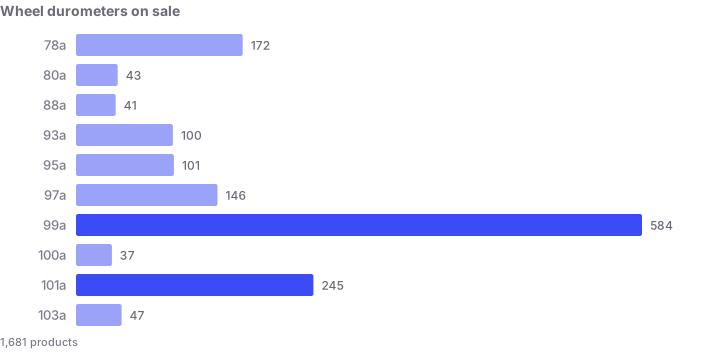
Of the 1,681 wheels in this comparator with the hardness in the title, 99a is 35% and 101a another 15% — between them they take almost half the market. Soft cruising wheels (78a-87a) are 19%. The rest of the scale splits what is left.
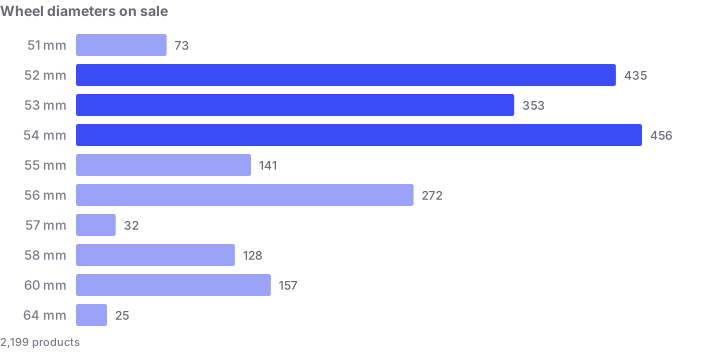
Diameters tell the same story: 57% of wheels are 52, 53 or 54 mm. When a guide tells you to “start with 99a in 53 mm”, it is not making that up — it is telling you where the market’s centre of gravity sits.
Hardness: the A scale (and the B)
Hardness is measured with a durometer and written as a number plus a letter. The vast majority of wheels use the A scale, which in practice runs from 78a (very soft) to 101a (very hard). Higher number, harder wheel.
Some brands, notably Bones with its skatepark line, use the B scale to measure urethanes above 100a accurately. The B scale reads 20 points below the A: an 84b equals 104a, and an 80b equals a classic 100a. That is not marketing — above 100a the A-scale needle loses reliability.
| Hardness | Feel | Best for |
|---|---|---|
| 78a – 87a | Soft, lots of grip | Cruising, city, rough ground |
| 88a – 95a | In between | Mixed street and cruising, starting out |
| 96a – 99a | Hard with some grip | All-round street and park |
| 99a – 101a | Very hard, fast, slidey | Street, skatepark, ledges and rails |
| 83b – 84b (≈103a-104a) | Extra hard | Concrete parks, fast bowls |
Diameter: top speed against acceleration
Diameter sets the trade-off between top speed and acceleration. A small wheel spins up sooner, accelerates faster and weighs less: ideal for technical tricks. A big wheel holds speed better and rides over cracks and grit without catching, but takes more effort to get going.
- 50-53 mm. Pure street, technical flips, ledges.
- 54-56 mm. The all-round middle ground. Start here if unsure.
- 56-60 mm. Park, bowls, transition and fast mini-ramps.
- 60 mm and up. Soft cruising and longboard wheels.
Contact patch and shape
The contact patch is the surface touching the ground. A wide patch gives more grip and stability; a narrow one breaks loose sooner, which many riders want for powerslides. The edge shape — conical, classic, radial — fine-tunes that: conical profiles offer less lateral friction, rounded ones more grip. It is not a critical first decision, but it explains why two wheels of the same hardness feel different.
Flatspots, and why good urethane resists them
A flatspot is a flat patch that appears when a wheel locks and drags on asphalt, typically in a powerslide. Once it is there the wheel buzzes on every rotation and nothing fixes it. High-quality, harder urethane resists that wear far better: this is why premium street wheels — Spitfire Formula Four, say — command their price, because they hold shape and speed season after season. Soft or cheap urethane flattens much sooner.
This is where price genuinely matters. Across the European catalog, the cheapest 10% of wheels goes for €29.99, the median is €55 and the priciest 10% reaches €74. The difference between a €30 set and a €60 set is not the colour: it is how long before the first flatspot.
Street, park or cruising
- Street. 99a-101a, 52-54 mm. Prioritise slide, low weight and flatspot resistance.
- Skatepark and transition. 97a-101a or 84b, 54-58 mm. A bit more wheel to hold speed in bowls. Ricta and Bones are strong here.
- Cruising. 78a-87a, 56-60 mm. They absorb rough ground and roll smoothly over cobbles. OJ and Slime Balls are the specialists.
If you put big soft wheels on a street deck, watch for wheelbite — the wheel rubbing the deck when you turn. You will usually need riser pads.
Before you buy
- Deck width limits which wheel fits without rubbing: size guide.
- High or low trucks change the biggest wheel you can run: hi and lo trucks guide.
- For what each part of a whole setup costs: price guide.
- And to see where these brands came from: industry timeline.
The manufacturers publish technical sheets for their urethanes, which is the serious source when comparing formulas: Spitfire, Bones and OJ. The hardness scale itself is the Shore durometer, an industrial standard rather than a skate invention.
Frequently asked questions
What wheel hardness is best to start with?
99a in 53-54 mm if you skate street and the park: it is literally half of what European shops sell, and for a reason. If your main use is getting around town, go 78a-87a.
Can I put soft wheels on a normal street deck?
Yes, within a size limit. Up to about 56 mm is usually fine; above that, add riser pads to avoid wheelbite. You gain comfort on rough ground and give up a little flip response.
What does 84b mean?
That it is a very hard wheel, equivalent to 104a. The B scale reads 20 points below the A and exists because above 100a the A scale loses precision.
How many wheels come in a set and what do they cost?
Sets are four. In the European catalog the median is €55, with entry level around €30 and the high end around €74.