A skateboard’s size is measured in inches of width, not length. That number, almost always between 7.5” and 9”, decides how the board feels underfoot, how quickly it turns, how it takes impacts and which style it favours. It is the first decision and the one you notice most.
What Europe actually sells
Before any recommendation, it is worth looking at the market. These are the widths the 78 shops in this comparator have in stock right now, across the 8,713 decks whose width is stated on the listing:
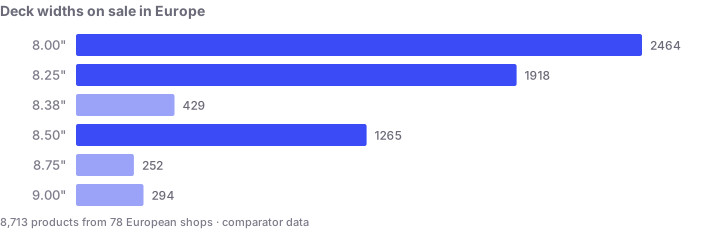
Three widths — 8.0”, 8.25” and 8.5” — account for 65% of everything sold. That is not a coincidence or a conspiracy among brands: it is the band where the vast majority of people find the balance between turning quickly and landing steady. If you are unsure and have no strong reason to leave it, the answer is almost always one of those three.
One surprise: a wider deck does not cost more. Taking the median price of each width, an 8.0” runs €67.96, an 8.25” €70 and an 8.5” €74.95; the 9.00” sits at €74.99. The differences come from brand and construction, not from inches. The one clearly cheaper band is 7.75” (€59.95), and that is because it concentrates kids’ boards.
The quick rule: height and style
| Height | Main style | Recommended width |
|---|---|---|
| Under 1.60 m or children | Street and skatepark | 7.5” – 7.75” |
| 1.60 – 1.75 m | Street, flatground, transition | 7.75” – 8.25” |
| 1.75 – 1.90 m | All-round, bowls, cruising | 8.25” – 8.5” |
| Over 1.90 m or pool | Transition, bowls, vert | 8.5” – 9” |
This is a reference, not a rule. There are tall skaters on 8.0” and short ones on 8.5”. The right size is the one that lets you do the tricks you want to do without thinking about it.
The foot trick, which beats height
Height is an approximation; your foot is a direct measurement. Put your shoe on the deck: your toes should reach near the edge without hanging over. As a guide:
| Foot size (EU) | Width that usually works |
|---|---|
| 38 – 41 | 7.75” – 8.0” |
| 42 – 43 | 8.0” – 8.25” |
| 44 – 45 | 8.25” – 8.5” |
| 46 and up | 8.5” – 8.75” |
What each inch changes
- Narrow (7.5” – 7.875”). Turn sooner, weigh less, excellent for technical flips and flatground. In exchange, less stable on bigger landings.
- Medium (8.0” – 8.25”). The balance that dominates the market. Works in street and in the park, and it is what we recommend to start.
- Wide (8.375” – 8.75”). More stability at speed and a far better platform on ramps and transition. Flips ask a little more, but you gain security.
- Very wide (8.875” and up). Bowl, pool and going fast. Outside that, you are carrying weight you do not need.
Beyond width: what nobody tells you the first time
Width is the starting point, not the end. Once it is settled, these three things are what really separate two decks of the same width:
- Wheelbase. Usually 13” to 14.5”. Short turns faster; long is steadier at speed. Two 8.25” decks can feel completely different because of this alone, and it is the number that appears least on product pages.
- Concave. How curved the deck is from edge to edge. A deep concave gives your feet more to grip for flips; a mellow one is more comfortable for cruising and transition.
- Construction. The standard is seven plies of Canadian maple pressed with glue. Beyond that there are decks with added fibreglass or carbon, epoxy resins or extra plies: they last longer and cost more. Powell Peralta and Santa Cruz both have named constructions of their own.
A note on shape: popsicle decks (symmetrical, with a nose and a tail) are the modern standard and what you should buy if in doubt. Shaped and old-school decks, wider and asymmetrical, are for bowl and cruising, and they make poor first boards.
Compare prices by size
If you already know what you want, go straight to every option in Europe with the lowest price for each model:
Or the full catalog, filtering by size in the toolbar. One warning: the same model, in the same size, can vary a great deal between shops — we documented one that varies by 114% — so it is worth checking before you buy. The price guide explains it.
And after the deck
- Wheels are the next decision and it changes a lot depending on where you skate: wheel guide.
- Trucks have to match the width of the deck, and getting it wrong is easier than it sounds: hi and lo trucks guide.
- If you are starting from zero, this is the right order.
Manufacturers publish their own sizing charts, and for a specific model that is the most reliable source: Independent maps deck width to truck size, and Santa Cruz and Powell Peralta document their constructions.
Frequently asked questions
What deck size is best to start with?
An 8.0” or an 8.25”. They are half the European market because they work for almost everyone and almost everything, and if you later want something more specific you will know which way to move.
Does a wider deck cost more?
No. Across the European catalog, the median price per width runs from €68 to €85 with no clear trend by width; price is set by brand and construction. The one clearly cheaper band is 7.75”, and that is because it holds a lot of kids’ boards.
What width do I need if I wear a size 44?
Between 8.25” and 8.5”. Check it by putting your shoe on the deck: your toes should reach near the edge without going past it.
Can I skate street on an 8.5”?
Yes. Size forbids nothing: it just means flips ask a bit more effort and landings are steadier. Plenty of street skaters ride 8.5” precisely because they prefer that trade.