Trucks shape how a board behaves more than any other part, and they last the longest: a good pair outlives several decks. The usual decision is Hi or Lo, two heights of the hanger — the horizontal piece the wheels bolt onto — but before getting there, one thing is worth understanding, because it can cost you €40.
First: one truck, or a pair?
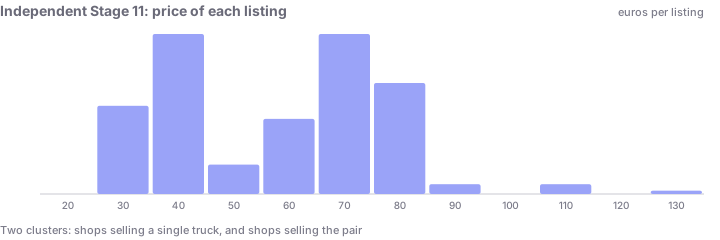
These are the prices of one single model, the Independent Stage 11, across the shops in this comparator. There is not one peak, there are two: one around €40 and another around €70–80. The reason is that some shops sell a single truck and others sell the pair, and the listing title often does not say. We found listings tagged “(pair)” in both clusters.
The practical rule: under €45, assume it is one truck until the shop’s own page says otherwise. A board needs two. Across the whole catalog, the median truck listing is €59.99, with the cheapest 10% at €29.95 and the priciest 10% at €85.80 — and a good part of that range is exactly this confusion.
What “Hi” and “Lo” measure
Height is measured from the baseplate to the top of the hanger. The well-known makers — Independent, Thunder, Venture, Ace — sort their trucks into three heights:
- Low (Lo): about 48-49 mm. Low profile, centre of gravity near the ground.
- Mid: about 52-53 mm. In between, versatile.
- High (Hi): about 55-57 mm. Tall profile, more clearance between ground and deck.
Seven or eight millimetres sounds like nothing and changes a great deal.
When to pick Hi
- Ramps and bowls. The board turns faster, the entry angle into curves feels more natural and you have more room to correct mid-air.
- Big wheels (54 mm and up). Hi keeps you clear of wheelbite — the wheel rubbing the deck when you turn. With 56-58 mm wheels, Hi is effectively mandatory.
- Cruising and speed. More stability, and the kicktail has more travel for manuals and kickturns.
When to pick Lo
- The lower centre of gravity makes flips feel quicker and the pop more explosive.
- Better connection to the ground for long grinds and slides.
- With small wheels (50-53 mm) there is no wheelbite risk and you gain agility.
And if you skate a bit of everything, Mid is the safe answer. Plenty of street pros ride Mid for exactly that reason.
Width: where most people get it wrong
Hanger width has to match deck width. This is the mapping the manufacturers use:
| Truck | Axle width | Deck width |
|---|---|---|
| 129 | 7.60” | 7.4” – 7.8” |
| 136 / 139 | 8.00” | 7.8” – 8.2” |
| 144 | 8.25” | 8.2” – 8.375” |
| 149 | 8.50” | 8.375” – 8.6” |
| 159 | 8.75” | 8.6” – 9” |
| 169 | 9.125” | 9” – 9.5” |
These are the figures from Independent’s own chart, read off their site on 2 September 2026. Worth saying, because the simplified mapping that circulates online does not match it: it starts the 149 at 8.25” where the manufacturer starts it at 8.375”, and it leaves out the 144 entirely — which is exactly what Independent recommends for an 8.25” deck.
Too wide and the board feels heavy and slow to turn; too narrow and it is unstable on landings. When in doubt, go to the closest without going over. Watch out for a naming trap: every brand numbers its trucks its own way. An Independent “149” and a Thunder “148” are practically the same width, and so is a Venture “5.8”. Always read the hanger millimetres, not the marketing number.
The table no brand publishes: cross-brand size equivalents
Here is the real problem, and it is what makes comparing trucks a mess: every house numbers by a different measurement.
- Independent and Thunder use a three-digit number that is roughly the hanger width in millimetres.
- Venture uses the hanger width in inches (a 5.8 is a 5.8” hanger).
- Krux uses the axle width in inches (an 8.25 is an 8.25” axle, not an 8.25” deck).
- Ace uses a house model code (22, 33, 44…) that measures nothing at all.
The one measurement all five publish is axle width, so that is the column to compare on. This table was built by reading all five official charts on 2 September 2026:
| Axle width | Hanger (mm) | Independent | Thunder | Venture | Ace | Krux | Slappy |
|---|---|---|---|---|---|---|---|
| 7.125” | — | — | 143 | — | — | — | — |
| 7.50” | 123,5 | — | — | — | — | — | 7.5 |
| 7.60” – 7.62” | ~127 | 129 | 145 | 5.0 | — | 7.6 | — |
| 7.75” | 130 – 132 | — | — | — | 22 | — | 7.75 |
| 8.00” | 136 – 137 | 136 / 139 | 147 | 5.2 | 33 | 8.0 | 8.0 |
| 8.25” | 143 | 144 | 148 | 5.6 | 44 | 8.25 | 8.25 |
| 8.50” | 149 | 149 | 149 | 5.8 | 55 | 8.5 | 8.5 |
| 8.75” | 155 – 156 | 159 | 151 | 6.1 | 60 | — | 8.75 |
| 9.00” | 162 – 163 | — | — | — | 66 | 9.0 | 9.0 |
| 9.125” | ~165 | 169 | 161 | — | — | — | — |
| 9.25” | 168 – 175 | — | — | — | 77 | — | 9.25 |
| 10.00” | 187 | 215 | 181 | — | — | — | 10.0 |
Read it carefully before buying a replacement. An Independent 149 and a Thunder 149 happen to be the same 8.5” truck. But an Independent 159 is not a Thunder 159 — Thunder does not make one — it is their 151. And a Krux “8.25” is not for an 8.25” deck: it is an 8.25” axle, which Krux itself recommends for decks from 8.00” to 8.25”.
The most confusing case is 8.25”. Independent calls it 144, Thunder 148, Venture 5.6, Ace 44 and Krux 8.25. Five completely different numbers for exactly the same part.
Six numbers, in fact, because Slappy calls it 8.25 too — its number is also the axle width — and publishes that this truck has a 143 mm hanger, exactly what Ace states for its 44. When two unrelated brands give the same figure, you know the millimetre column is the one to trust.
Film: a grid of its own that lines up with nobody
Film, Jérémie Daclin’s brand (the founder of Cliché), numbers like Venture — hanger width in inches — but on a grid of its own in ten-millimetre steps: 5.0 (125 mm), 5.25 (135 mm), 5.5 (145 mm), 6.0 (155 mm) and 6.5 (165 mm). The trouble is that those values fall between everyone else’s: a Film 5.5 is 145 mm, and the standard sizes either side are 143 (an 8.25”) and 149 (an 8.5”). It is neither. If you are replacing a set of Film with another brand, choose by the deck you ride, not by the number.
Three brands that publish nothing
Tensor, Royal and Silver are among the best sellers in European shops — Silver and Tensor are the fifth and sixth biggest in this catalog — and none of the three has a size chart you can consult today:
- Tensor’s site is down (“We’ll be back soon”, with a link to buy on Amazon).
- Royal’s domain does not resolve.
- Silver’s serves a frameset redirecting to a domain with nothing to do with skateboarding: it is parked, it is not the brand.
In shop listings Royal appears numbered both ways at once (5.0 and 5.25 in inches, but also 139, 144, 149 and 159 in millimetres), while Tensor and Silver use hanger inches only. Since none of that can be checked against the manufacturer, they stay out of the table: better a gap than a figure we cannot stand behind.
The parts nobody looks at, which change everything
Trucks are not a solid block: they are a set of adjustable, replaceable parts.
- Bushings (the rubbers). They are what actually decides how stiffly the truck turns, and they cost €5–15. Swapping them softer or harder transforms the feel far more than changing brand. If new trucks feel “too stiff”, the bushings are usually the problem, not the trucks.
- The kingpin, the central bolt compressing them. Tightening or loosening it is the free, instant adjustment: loose turns more, tight rides steadier.
- Baseplate geometry. This is why two brands of the same width turn differently, and why people stay loyal to one for decades.
- The pivot cup, the plastic seat the hanger rests in. When a truck squeaks or feels loose, it is often this, and it costs a couple of euros.
Compare prices
You can compare the most popular trucks across the 78 European shops with tracked stock:
- Independent · Thunder · Venture · Ace · Krux
Or the full catalog. Remember to check whether the price is for one truck or the pair before comparing.
The practical answer
- Street with small wheels → Lo, and the width off the table above: 139 for 7.8”-8.2”, 144 for 8.25”, 149 from 8.375” up.
- Bowls, ramps or cruising → Hi.
- Not sure → Mid.
And remember trucks last years. They are one of the few parts you can keep for half a lifetime, and one where spending a bit more genuinely pays.
Keep going
- Deck width governs truck width: size guide.
- Truck height caps the biggest wheel you can run: wheel guide.
- What a whole setup costs: price guide.
- Where these brands came from and who makes them: industry timeline.
Manufacturers publish their own sizing charts, which are the reliable reference for a specific model: Independent and Thunder.
Frequently asked questions
Hi or Lo to start?
Mid, or Lo if you mostly skate street on 52-54 mm wheels. Neither will stop you learning anything; the difference shows up once you have a style.
Why do some trucks cost €38 and others €85?
Often because one is a single truck and the other is the pair. Once you account for that, the real gap between entry level and premium is usually hanger material (forged versus cast aluminium) and weight.
What truck width do I need for an 8.25” deck?
By Independent’s own chart, a 144: its bracket runs 8.2” to 8.375”. The 139 stops short (it ends at 8.2”) and the 149 does not start until 8.375”. Plenty of people run a 139 or a 149 on an 8.25” and skate it happily — a millimetre or two of overhang per side ruins nothing — but the width the manufacturer recommends is the 144. And always read the hanger millimetres rather than the marketing number, since every maker numbers differently.
Do trucks wear out?
The body barely does, which is why they last years. What wears are the bushings and the pivot cup, which cost a few euros and take five minutes to change. Before buying new trucks, try new bushings.