The short answer, if you have never skated yourself: from age 5, with an adult nearby, and a deck chosen by your child’s foot, not by the age printed on the box. The comparator lists 334 decks in kids’ widths — 7.0” to 7.75” — across 78 European shops, with a median of 64,95 € (the median is the middle price: half cost less). That money buys wood that lasts and parts that actually spin.
What age a child can start
The health guidance is fairly consistent. The American Academy of Pediatrics says that children under 5 should not ride skateboards and that children aged 6 to 10 need close adult supervision. Parachute, the Canadian injury-prevention organisation, says the same: from age 5, and supervised until 10.
Those ages are about coordination, not about sizing. Once you have decided your child can get on a board, forget the age: what matters is shoe size, and then weight. An adult deck is stiff and heavy, and a light child does not have the strength to lift its nose or turn it. Buying a board “to grow into” is the surest way to make them quit.
Which width they need
Decks are measured by width in inches (the " symbol), never by length. A 7.5” deck is seven and a half inches edge to edge, about 19 cm. The practical rule: with a shoe on, the foot should reach close to the edge without hanging over it.
| Shoe size (EU) | Rough age | Recommended width |
|---|---|---|
| 26 – 30 | 4 – 6 years | 7.0” – 7.25” |
| 31 – 34 | 6 – 8 years | 7.25” – 7.5” |
| 35 – 37 | 8 – 11 years | 7.5” – 7.75” |
| 38 and up | 11 years and up | 7.75” – 8.0” (already an adult size) |
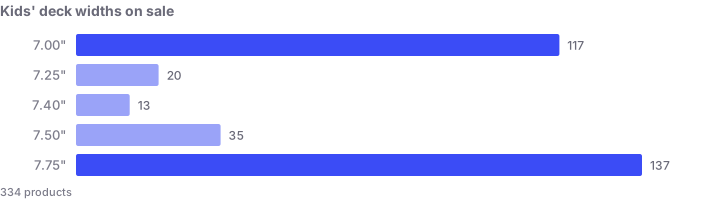
What is actually on sale, though, is not evenly spread: of those 334 kids’ decks, 117 are 7.00” and 137 are 7.75” — three in four. The sizes in between are scarce: 35 at 7.50”, 20 at 7.25” and 13 at 7.40”. So if you set out looking for a 7.25”, you will end up settling for the neighbouring size. That is fine: a quarter of an inch matters far less than the gap between a good deck and a bad one.
Browse 7.0” decks, 7.5” decks or 7.75” decks, or filter by size in the catalogue.
What it costs, and what too cheap really means
| Deck price | |
|---|---|
| Cheapest (bottom 10%) | 41,99 € |
| Typical price (median) | 64,95 € |
| Most expensive (top 10%) | 119,95 € |
Careful: that is the deck alone — the wood with grip tape, no trucks and no wheels.
One detail works in your favour: the median across all decks in the catalogue is 74,90 €, but the 7.75” band is the cheapest in the whole market at 59,95 €, precisely because it is where the kids’ decks pile up. It is at once the large size among kids’ boards and the small one among adult boards, and the point where you pay least for equivalent quality. If your child can already handle it, it is an excellent buy.
The reverse tells you something too: if the cheapest 10% already costs 41,99 € and that is only the wood, a 25 € “complete skateboard” from a toy shop cannot contain the same materials. It is not a bargain; it is a different product.
Complete or piece by piece
A complete comes assembled and ready to ride: deck, trucks (the metal parts that hold the wheels and let the board turn), wheels, bearings, hardware and grip tape. Building piece by piece means buying every component separately.
For a child, the complete wins almost every time, and the numbers say it plainly: 64,95 € for the deck, 59,99 € for a set of trucks, 55 € for a set of wheels. That is 180 € before bearings, grip and bolts — above the most expensive 10% of the entire kids’ segment (119,95 €).
And cost is not even the strongest argument:
- Trucks have to match the deck width. It is the most common mistake in a first build, and harder to get right in kids’ sizes because narrow trucks are uncommon. A complete arrives already matched.
- The board will last two or three years at most. Paying for premium parts they will outgrow makes little sense.
- You do not have to decide anything. Wheel durometer and truck height are questions that give you nothing in the first year.
Building piece by piece arrives on its own: when they snap the wood, keep the trucks and wheels and buy only the deck. That is when the catalogue and the price guide start saving you real money.
The toy-shop board trap
The market is full of four-wheeled things that are not skateboards. Telling them apart is easy:
- The wood. It must be seven plies of pressed maple. If the listing does not say what the wood is, or just says “wood”, or the board is plastic with a print on it, it is not a skateboard. This is the single most reliable signal.
- How the size is advertised. Real decks are sold by width in inches (7.5”, 7.75”). Toy boards are sold by length in centimetres — “79 cm skateboard” — because the number sounds bigger. No inches anywhere is a bad sign.
- The bearings. These are the parts that let the wheel spin; they are always size 608, the same worldwide, and they must carry a brand or at least a reference. Unmarked bearings stop dead after three metres, and that is what makes a child conclude they are no good at it. More in the bearings guide.
- The trucks. Aluminium, with a central kingpin nut you tighten or loosen with a wrench to adjust how easily the board turns. If there is nothing to adjust, it is not a skateboard truck.
- The weight. A real board is light and the child should be able to carry it alone. Toy boards are often heavier because they make up for poor wood with thickness.
If a specific model makes you hesitate, check the European Commission’s Safety Gate, where national authorities publish products pulled from the market as dangerous.
Protective gear
The helmet is not negotiable, and it has to fit now, not in two years. According to Parachute, a properly fitted helmet cuts the risk of traumatic brain injury by 45%. A skate helmet is also built to survive several impacts, whereas many bike helmets are designed to absorb one and then be replaced.
For the rest, the American Academy of Pediatrics gives clear figures: wrist guards prevent almost 90% of wrist injuries, elbow pads 80% and knee pads 30%. If you have to prioritise, wrist guards come right after the helmet: the most common skating injury is a broken or sprained wrist, because everyone’s reflex when falling is to put their hands out.
When it is time for a new deck
Signs they have outgrown it:
- The foot, in a shoe, hangs over the edge.
- They have gone past EU shoe size 38.
- They complain the board wobbles on landing: a deck that is too narrow forgives very little.
- The wood is done: nose and tail worn to a point, plies splitting, or it has lost its pop (the curve that makes the board snap up when you slap the tail down).
The natural step is to 7.75” or 8.0”. Good news: from that size on you no longer need anything labelled “kids”. You are in the normal market — far bigger — with 7.75” as the cheapest size in the catalogue. If the trucks and wheels are in good shape, keep them. For the exact width, see the sizing guide; if they are already skating the park on their own, the beginner’s guide.
Frequently asked questions
How old does a child have to be to skate?
Under 5, no; between 6 and 10, an adult should be nearby. Beyond that, what decides the deck is not age but shoe size.
Which width suits a 7-year-old?
It depends on the foot. At EU 31-34, between 7.25” and 7.5”; if they already wear a 35, go to 7.5” – 7.75”. Put their shod foot on the deck: the toes should reach near the edge without passing it.
Is a 25 € skateboard worth it just to see if they like it?
No, and it backfires. The cheapest 10% of kids’ decks in the catalogue already costs 41,99 € for the wood alone. A 25 € complete has bearings that do not spin and trucks that do not adjust, and the predictable outcome is a child who decides skateboarding is not for them.
Do they need a helmet if they only skate on the square downstairs?
Yes. Serious head injuries mostly happen in ordinary low-speed falls, not doing tricks. A helmet costs far less than the board and changes how a fall ends.
How often will I have to buy a new deck?
Every two to three years if they skate regularly. The first one is usually outgrown by shoe size; the second, by wear. Once they reach 7.75” they can stay on the same size for years.