Shoes are the most expensive part of your skateboard. The comparator’s catalog holds 901 shoes from 19 brands across 78 European shops, and the median price — always taking the cheapest offer for each model — is €89.95. A deck on its own has a median of €74.90, a set of trucks €59.99 and a set of wheels €55. Put another way: putting shoes on costs more than the wood you stand on, and they last far less.
So it is worth knowing what you are paying for. And almost all of it comes down to one decision: vulcanised sole or cupsole.
Vulcanised or cupsole: the only decision that changes anything
A vulcanised sole is made by gluing a strip of rubber to the upper and curing it with heat and pressure. What comes out is a thin, flexible sole: the shoe bends almost like a reinforced sock. That gives you what skaters call board feel: you feel the edge, you feel the grip, and you know where your foot is when you flip. They need no break-in — day one they are ready.
A cupsole starts from a sole moulded into the shape of a cup — hence the name — with the upper fitted and stitched inside it. It is thicker, often with a foam midsole, and it has side walls that climb up around the edge of your foot. You gain cushioning, protection and durability, because there is far more rubber to wear through. You lose sensitivity and lightness, and you have to count a few days before it flexes where it should.
| Vulcanised | Cupsole | |
|---|---|---|
| Construction | Rubber strip glued on and heat-cured | Cup-shaped sole with the upper stitched inside |
| Board feel | Immediate, you feel the edge and the grip | Filtered, you feel less of the wood |
| Cushioning | Minimal | Much more, especially at the heel |
| Break-in | None | A few days |
| Durability | Lower | Higher |
| Weight | Light | Heavier and stiffer |
The historical split is clear: vulcanised is Vans territory, cupsole belongs to the sports brands that came into skating, like Nike SB. But the line blurred years ago and every big brand now sells both: Emerica runs vulcanised models and cushioned cupsoles side by side in the same price bracket, and Lakai labels each model with its construction. If you are torn, the useful question is not “which is better” but “what hurts more right now: not feeling the board, or my heels”.
Why they always blow out in the same place
Pick up the worn shoes of anyone who skates: the hole will be on the outer side of the front foot, above the little toe, just ahead of the laces. That is the ollie zone, and it is no accident.
When you ollie or kickflip you drag your front foot upwards against the grip, which is literally sandpaper glued to wood. Every attempt is one more pass of a file over the same patch of fabric. The shoe always loses; the only thing you get to decide is how long it takes to lose.
Here is what brands do to drag that fight out, and what you should be looking at when you compare models:
- Suede instead of canvas. This is the single biggest difference: a canvas ollie zone opens up in weeks, and suede handles abrasion far better.
- A one-piece toe or an ollie patch. Every seam is a weak point, because the thread cuts before the leather does. Fewer seams in the critical area means more life.
- Underlays and double layers beneath the outer material, exactly where the foot rubs, plus double or triple stitching where the toe meets the side panel.
- Protected laces, either under a flap or with the eyelets moved inboard so the grip cannot saw through them.
- Tougher outsole rubber. etnies, for instance, has kept a Michelin-soled line going for years so the tread survives longer before going smooth.
Look at these things before you look at the colourway: they are the only part of the description that will tell you whether the shoes last two months or six.
Where you skate decides what you need
- Street with stairs and gaps: cupsole. What will hurt you in the long run is repeated heel impact, not the board.
- Flat, ledges and technical skating: vulcanised. You want to feel the board and you want a shoe that does not lie to your flick.
- Bowls and concrete transition: cupsole with a pronounced tread; concrete eats rubber fast.
- City and commuting: either. Here it is comfort and materials that survive daily use that matter.
Sizing: they do not fit like street shoes
This is the part that drives most returns. Two shoes with the same European number from two different skate brands can fit noticeably differently, and neither has to match your street shoes: the last, the thickness of the tongue and the internal padding all change how the shoe ends up feeling.
The reliable method is boring: measure your foot in centimetres — heel against the wall, mark the longest toe, ruler — and compare that figure against that brand’s own centimetre chart, not the European number. Do it at the end of the day, when your foot is at its most swollen, and with the sock you will actually skate in.
Two caveats: a vulcanised shoe gives and moulds to your foot within a few sessions, while a cupsole softens but does not widen much. And going loose is no solution, because if your foot moves inside the shoe the ollie zone wears through sooner. If you can, try the model on in a physical shop and then compare its price in the shoes section.
What they actually cost
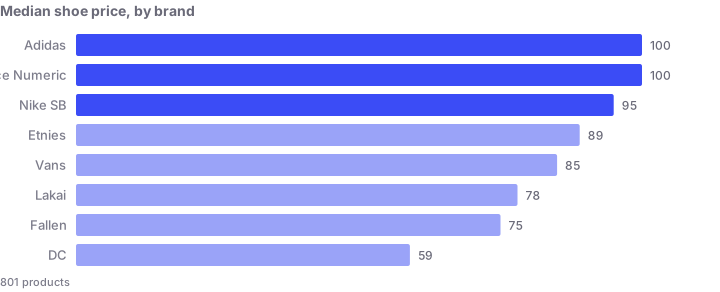
These are the catalog prices, always the cheapest offer for each model:
| Percentile | Price |
|---|---|
| p10 | €54.95 |
| p25 | €75 |
| Median | €89.95 |
| p75 | €109.95 |
| p90 | €119.99 |
The market clusters between €75 and €110: below €55 there is almost nothing, and above €120 not much either. By brand the spread is considerable:
| Brand | Models in the catalog | Median price |
|---|---|---|
| Nike SB | 228 | €94.99 |
| Adidas | 171 | €100 |
| New Balance Numeric | 115 | €99.95 |
| Vans | 64 | €84.95 |
| Lakai | 64 | €77.50 |
| DC | 35 | €59 |
| Fallen | 30 | €74.90 |
Nike SB, Adidas and New Balance Numeric set the top of the range, around €95-100, and they are also the brands with the most models in the catalog. DC (€59), Fallen (€74.90) and Lakai (€77.50) are the clearly cheaper options, with Vans in the middle. The gap between a pair of DCs and a pair of Adidas is basically the price of a set of wheels; you can cross-check that against the full breakdown in the price guide.
Alongside the big brands there are European projects like Last Resort AB, founded in 2020 by Pontus Alv, playing in that same upper bracket. The wider picture is in the guide to European skate brands.
How long they really last
There is no honest number I can give you: it depends on how many hours you skate, how many flips you do and how abrasive your grip is. Someone doing technical tricks every day can put a hole through a vulcanised shoe in a few weeks; someone rolling around town who rarely ollies can get a whole season out of the same pair.
What is predictable is how they die, and always in this order:
- The ollie zone opens up and the hole appears.
- The outsole loses its tread, goes smooth, and you stop getting grip on the tail.
- On cupsoles, the midsole packs down and you start feeling every impact in your heels.
The first stage can be delayed: it is common practice to seal the area with shoe glue before the hole opens, and to keep two pairs in rotation. The third cannot be undone: once the foam is dead it is dead, however intact the shoe looks from outside.
Run the numbers at your own rate before you settle on a price bracket. Three pairs a year at the median is €269.85, more than a deck, a set of trucks and a set of wheels combined (€189.89). It is the most expensive consumable in skating, which is why choosing the right material in the ollie zone pays off more than choosing the right colour.
Frequently asked questions
Can I skate in ordinary trainers?
You can, but they will not last and you will skate worse. A running shoe has a soft, curved sole with no flat contact surface and no reinforcement in the ollie zone: it blows out immediately and your foot never settles properly on the grip.
Vulcanised or cupsole to start with?
Vulcanised. A beginner needs to feel the board far more than they need to cushion impacts they are not making yet, and it is usually the cheaper option. Once you start going down stairs, move to a cupsole.
How long do skate shoes last?
There is no fixed number: it depends on hours, tricks and grip. What you can count on is that the ollie zone will open well before the sole wears out.
Do skate shoes fit like street shoes?
Often not, and they do not fit the same across brands either. Measure your foot in centimetres and trust each brand’s own chart rather than the European number, and account for the sock you skate in.
Is it worth paying €120 instead of €60?
It depends what the difference buys. If it is better suede, a one-piece toe and reinforced stitching, yes. If it is a collaboration or an exclusive colourway, no. And before you decide: the price gap for the same model between shops is often bigger than the gap between price brackets, and you can check that at /en/shoes.